Every day, millions of messages fly back and forth across Snapchat, TikTok, Instagram, Discord, and regular text threads — and a huge chunk of them are written in a language that barely resembles standard English. A single letter can mean an entire sentence. A three-letter abbreviation can carry a whole emotion. If you’ve ever stared at a reply and thought, “wait, what does that actually mean?” — you’re not alone, and you’re in the right place.
This guide breaks down the most common texting slang and social media abbreviations used in 2026, across every major platform. Whether you’re a parent trying to understand your teenager’s messages, someone new to a friend group’s chat style, or just someone who wants to keep up, this is your complete reference.
What Is Texting Slang and Why It Matters in 2026
Texting slang refers to the shortened words, abbreviations, and casual expressions people use to communicate faster in digital conversations. It exists because typing full sentences on a phone takes time, and most casual conversations don’t need that level of formality anyway.
In 2026, texting slang isn’t just a teenage habit — it has spread across age groups and platforms. Snapchat, TikTok comment sections, Discord servers, group chats, and even workplace messaging apps all have their own dialects of shorthand. Understanding this slang helps you communicate naturally, avoid misreading a friend’s tone, and stay current with how language keeps evolving online.
Most Common Texting Abbreviations You’ll See Every Day
These are the abbreviations you’ll run into constantly, no matter which app you’re using.
| Abbreviation | Meaning |
|---|---|
| LOL | Laughing Out Loud |
| BRB | Be Right Back |
| NGL | Not Gonna Lie |
| FR | For Real |
| TBH | To Be Honest |
| IMO | In My Opinion |
| IDC | I Don’t Care |
| SMH | Shaking My Head |
| RN | Right Now |
| WYD | What Are You Doing? |
| TTYL | Talk To You Later |
| FOMO | Fear Of Missing Out |
| GOAT | Greatest Of All Time |
| OTW | On The Way |
| ILY | I Love You |
These abbreviations act as the “core vocabulary” of digital conversation — once you know them, most everyday texts become much easier to follow.
Snapchat-Specific Slang and Features Explained
Snapchat has its own ecosystem of slang and built-in features that confuse a lot of new users. Beyond common terms like “streaks” (the number of consecutive days two people have snapped each other) and “snap score” (a point system based on activity), Snapchat also has messaging features with their own terminology — like time-sensitive content.
One of the most searched Snapchat-related questions is what the “time sensitive” label actually means when it appears on a message. In short, it refers to disappearing content that automatically deletes after being viewed or after a set countdown — Snapchat’s way of keeping conversations temporary rather than permanent. If you want the full breakdown of how this feature works, including privacy settings and screenshot notifications, this guide on time sensitive mean on snapchat covers it in complete detail.
Snapchat conversations also move fast, which is exactly why abbreviated replies are so common there — a full sentence takes too long when the chat is already moving on to the next topic.
TikTok and Instagram Slang You Should Know
TikTok comment sections and Instagram DMs have developed their own casual shorthand, often shaped by trends, sounds, and creator culture.
| Slang | Meaning |
|---|---|
| No cap | No lie / I’m serious |
| It’s giving… | It has the vibe of… |
| Rizz | Charisma, especially romantic |
| Main character energy | Acting confident and central to your own story |
| Slay | Doing something impressively well |
| Delulu | Delusional (usually playfully) |
| Ate | Did something exceptionally well |
| Understood the assignment | Did exactly what was expected, perfectly |
These terms move quickly in and out of popularity, often tied to a specific trend or sound that goes viral and then fades within weeks or months.
Gaming Slang and Abbreviations Every Player Should Know
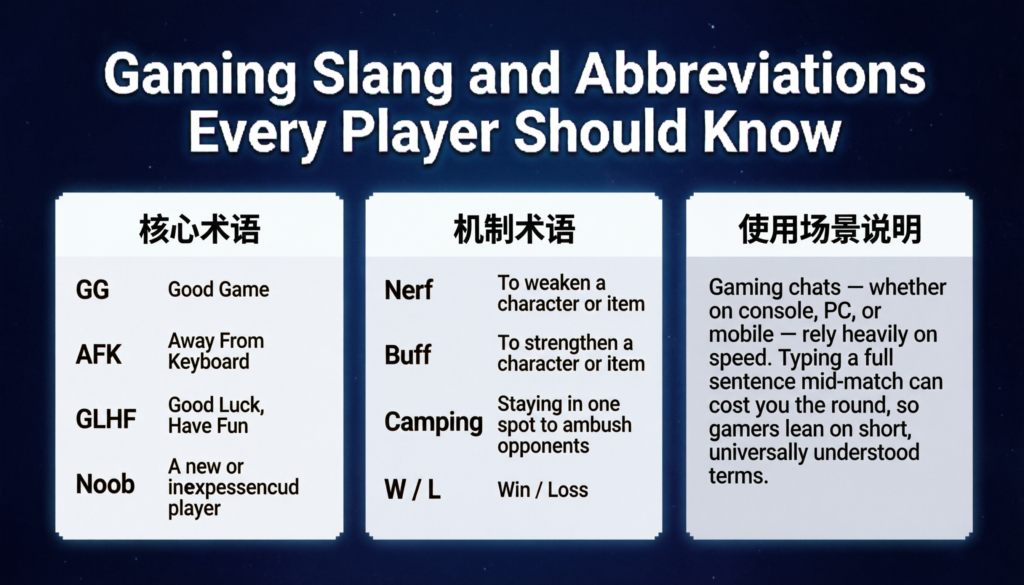
Gaming chats — whether on console, PC, or mobile — rely heavily on speed. Typing a full sentence mid-match can cost you the round, so gamers lean on short, universally understood terms.
| Gaming Slang | Meaning |
|---|---|
| GG | Good Game |
| AFK | Away From Keyboard |
| GLHF | Good Luck, Have Fun |
| Nerf | To weaken a character or item |
| Buff | To strengthen a character or item |
| Camping | Staying in one spot to ambush opponents |
| Noob | A new or inexperienced player |
| W / L | Win / Loss |
These terms are used across popular titles like Fortnite, Call of Duty, Valorant, Minecraft, and Roblox, making them essential knowledge if you’re chatting in any multiplayer lobby.
Popular One-Word Replies and What They Really Mean
Some of the most common texts you’ll receive are just one word — and yet they carry a surprising amount of meaning depending on tone, punctuation, and context.
Take “igh,” for example. On the surface, it looks like a random string of letters, but it’s actually a shortened version of “aight,” which itself is short for “alright.” People use it to agree, accept plans, or casually end a conversation — and depending on the emoji attached to it, it can come across as friendly, neutral, or mildly annoyed. If you want a full breakdown of how this word is used across Snapchat, TikTok, Instagram, and gaming chats, this detailed guide on igh meaning covers every context with real examples.
Other common one-word replies include:
| Reply | Typical Meaning |
|---|---|
| Bet | Agreement, confirmation (“Sure, deal”) |
| K | Okay (can sometimes feel curt) |
| Fr | For real / I’m serious |
| Same | Shared feeling or experience |
| Mood | Relatable feeling |
| Facts | Agreement with a strong statement |
One-word replies are efficient, but they can also be misread — which is exactly why understanding their common usage matters.
How Gen Z and Millennials Use Slang Differently
While both generations use texting slang heavily, there are noticeable differences in style. Gen Z tends to favor ironic, exaggerated expressions (like “delulu” or “it’s giving…”), often layering sarcasm into casual conversation. Millennials, on the other hand, grew up with the earlier wave of texting abbreviations like LOL, BRB, and OMG, and tend to use slang a bit more literally.
Platform habits also differ — Gen Z conversations are more likely to reference TikTok trends and sounds, while millennials lean more toward Facebook-era phrases and straightforward abbreviations. Neither style is “correct”; they simply reflect the platforms each generation grew up communicating on.
Common Mistakes to Avoid When Using Texting Slang
- Assuming everyone knows the term. Older relatives, teachers, or coworkers may not recognize slang that feels obvious to you.
- Using it in professional settings. Emails, work chats, and formal messages should stick to complete words.
- Overusing one phrase. Repeating the same abbreviation in every message can make conversations feel flat — mix it up with full words occasionally.
- Ignoring tone context. The same slang term can read as friendly or dismissive depending on punctuation and emojis, so pay attention to how it’s framed.
- Misreading intent. A short reply doesn’t always mean disinterest — sometimes it’s just how someone naturally texts.
Texting Slang vs. Professional Communication — When to Switch
Knowing when to use slang and when to switch to standard language is just as important as knowing the slang itself. Casual abbreviations are perfectly fine with friends, close family, and peer group chats. However, professional emails, job applications, customer service messages, and conversations with teachers or supervisors call for complete, clear language.
A simple rule of thumb: if you wouldn’t say it out loud in a formal meeting, don’t type it in a formal message either.
FAQs
What is the most commonly used texting abbreviation? LOL remains one of the most universally recognized texting abbreviations, though newer terms like “fr” and “ngl” have become just as common among younger users.
Is texting slang only used by teenagers? No. While teenagers and young adults tend to adopt new slang first, texting abbreviations are now used across nearly all age groups, especially in casual conversations.
Does texting slang mean the same thing on every platform? Not always. Some slang, like Snapchat’s time-sensitive messaging terminology, is platform-specific, while general abbreviations like LOL or BRB carry the same meaning everywhere.
Why do gamers use so many abbreviations? Because typing during a live match takes valuable time, gamers rely on short, universally understood terms to communicate quickly without disrupting gameplay.
Should I avoid using slang in a job interview text or email? Yes. Professional communication should always use complete words rather than casual abbreviations, regardless of how comfortable the conversation feels.
How can I keep up with new slang terms? Paying attention to how younger family members, TikTok trends, and popular creators communicate is one of the easiest ways to stay current, since most new slang spreads through social media first.
Is it rude to reply with just one word? Not usually. Short replies like “igh” or “k” are often just efficient, casual responses rather than a sign of disinterest — though tone and context can sometimes suggest otherwise.
Will texting slang keep changing in the future? Yes. Digital language evolves constantly as new platforms, trends, and cultural moments emerge, meaning today’s popular slang will likely be replaced by new terms within a few years.
Conclusion
Texting slang isn’t just random shorthand — it’s a living, evolving language shaped by speed, culture, and the platforms we communicate on every day. From simple abbreviations like LOL and BRB to platform-specific terms like Snapchat’s time-sensitive messages or the ever-versatile “igh,” understanding this digital vocabulary makes conversations easier to follow and helps you connect more naturally with the people you’re texting.
As new trends and platforms continue to shape how we communicate, one thing stays constant: slang will keep evolving, and staying a little curious about it goes a long way toward keeping up with the conversation.

I’m Olivia, an AI content writer with 3+ years of experience in creating SEO-optimized and engaging content. I focus on delivering high-quality articles that help websites grow and rank better on search engines.